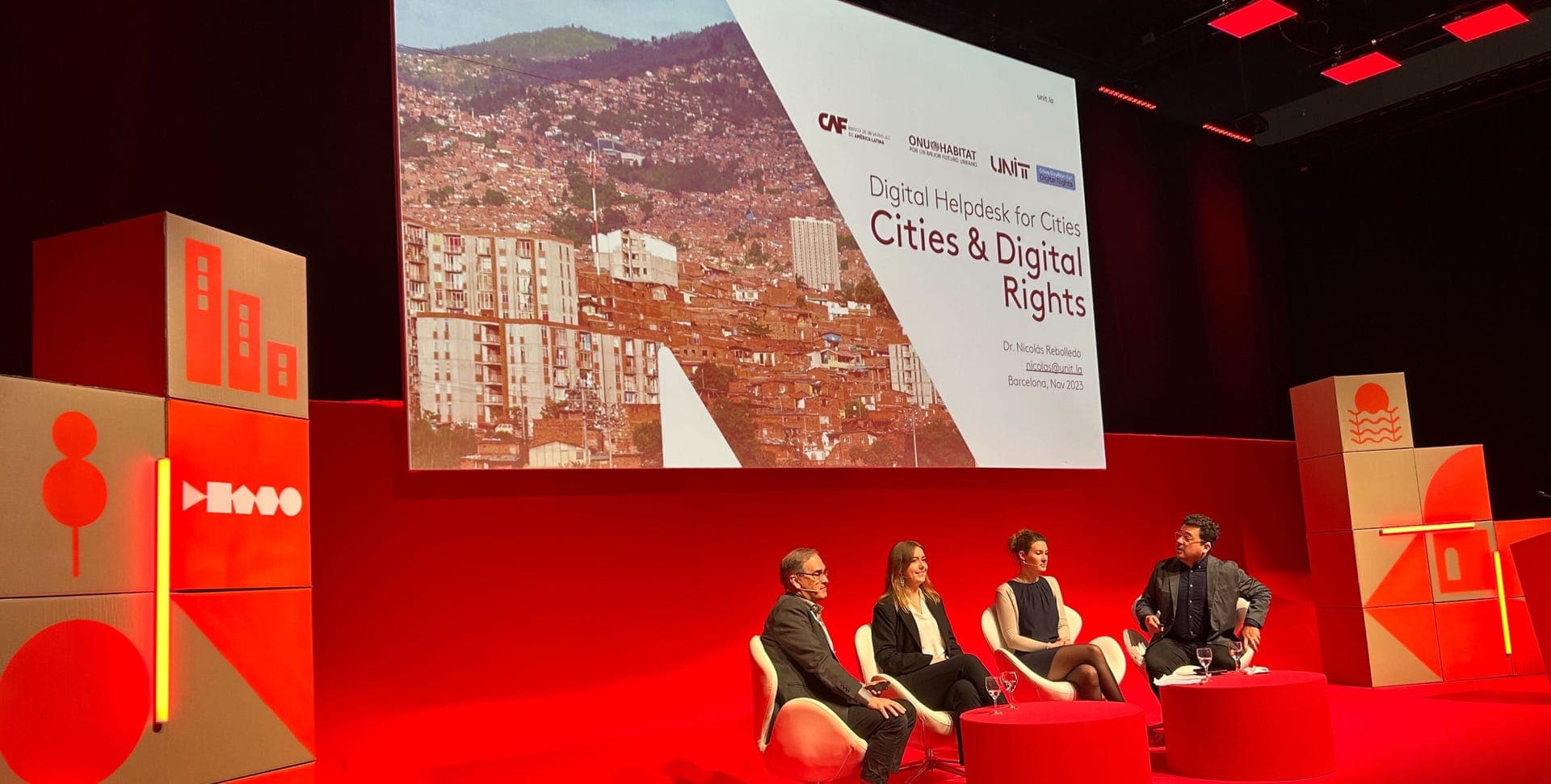

Integrating human rights into the digital transformation of cities together with CAF and UN-Habitat
UNIT worked with CAF and UN-Habitat to design a regional collaboration infrastructure that translates the human rights approach into practical design tools, strengthening the capacities of Latin American local governments to lead people-centered digital transformations.

When digitization is not just a technical problem, but a public design one
In Latin America, digital transformation is advancing urgently, but without a rights-based compass. Many cities in the region are promoting the digitization of their public services—online platforms for procedures, open data systems, citizen participation tools—without methodological frameworks that allow for the systematic incorporation of normative and rights-based dimensions such as privacy, transparency, inclusion, and participation in the new transformation processes. The gap is not only regulations: it's a design gap.
This situation is exacerbated by the structural conditions of the Latin American contextMunicipal teams face limitations in technical capabilities, staff turnover due to political cycles, and limited access to comparative experiences. Smart city and digital modernization agendas, often designed in the Global North or at central levels of government, prioritize technological efficiency over people's experience and long-term institutional strengthening. International frameworks on digital rights existed, but remained abstract documents, disconnected from the daily decisions that shape urban digital transformation.
Added to this is a profound fragmentation: our cities have diverse needs, ranging from equality and digital inclusion to open infrastructure and accountability. But each city faced these challenges in isolation, without peer learning spaces or common tools. Human rights are not integrated into the processes, methodologies, and decisions that shape people's digital lives in cities.
“Incorporating a human rights approach into public policy is a challenge for those responsible for leading these digital transformation processes in cities, especially when the theoretical frameworks are mostly developed in the Global North and the conditions for their implementation are radically different in Latin America.”
Designing collaboration: from the regulatory framework to the applicable tool
The commission was ambitious and multidimensional: CAF and UN-Habitat called on UNIT to conceptualize, design and execute a regional project with the aim of placing Latin American cities in a global conversation about digital transformation centered on people and with a focus on human rights.
UNIT assumed full technical responsibility for the project: it conducted field research with 30 digital rights specialists from across the region, designed and facilitated the incubation program with three Latin American cities, conceptualized the architecture of a Cities and Digital Rights Platform as a peer-to-peer learning service, and led the production of the first regional practical guide that translates international human rights frameworks into design tools applicable to municipal management.
Specifically, UNIT operated as the methodological orchestrator of a process that brought together multilateral organizations, local governments from three countries, a network of more than 30 international experts, and a community of more than 100 public servants, transforming a global problem—digitalization without a rights-based approach—into a set of concrete, situated, and replicable instruments for the Americas.Latina.
UNIT led the strategic and methodological design of the project, understanding that human rights are not an additional layer to digital transformation, but a structural component of its design.The change in logic was fundamental: it was not about producing another document of principles, but about building a service architecture that would make digital rights usable for specific municipal teams.
The work was organized around three converging lines. First, a situated research process that combined the analysis of international frameworks with 30 semi-structured interviews with specialists from non-governmental organizations, foundations, citizen groups, and academia throughout the region. This diagnostic process allowed for a critical examination of global theoretical frameworks in light of the actual conditions of implementation in local Latin American public institutions, identifying common gaps and opportunities for intersectoral collaboration.
Second, UNIT designed and facilitated a three-month incubation program with the cities of Mexico City, Medellín, and Niterói, selected from among 36 applicants. The program included collaborative sessions between municipal teams, individual mentoring with experts, and virtual exchange roundtables with European cities such as Brussels, Dublin, Sofia, and Tirana. This collaborative innovation not only generated solutions for each city but also allowed for the mapping of replicable needs at a regional level.
In parallel, the conceptual model for the Cities and Digital Rights Platform was designed as a learning service among cities. This involved defining its value proposition, the logic of participation, the types of content, and the mechanisms for community activation. The platform was conceived as an infrastructure for ongoing collaboration, not as a one-off product.
Finally, the development of the regional practical guide became the structuring axis of the approach. Its development combined research, co-creation with public servants, dialogue with specialists, and the systematization of real-world practices, transforming expert knowledge into clear instruments for public decision-making. Each recommendation was organized around three operational dimensions: foundations (regulatory frameworks), structures (governance models), and tools (practical implementation actions), distributed across six thematic areas of work.
“With this guide, we are adding a new dimension to people-centered service design: the promotion and protection of human rights in digital transformation processes. This process allowed us to recognize the importance of strengthening digital transformation teams, creating long-term mechanisms, and building networks for collaboration and the exchange of best practices and knowledge among cities.”
Results
| Deliverable | Type | Description |
|---|---|---|
| Regional practical guide on digital transformation with a human rights approach | Publication | The first practical guide in the region that translates international digital rights frameworks into design criteria, working tools, and applicable recommendations for municipal teams. Four chapters covering regulatory frameworks, regional analysis, city experiences, and practical recommendations. |
| Digital Cities and Rights Platform | Digital platform | An international learning space between cities to share projects, showcase experiences and facilitate access to practical resources geared towards digital transformation with a human rights approach. |
| Incubation and mentoring program | Capacity building process | A three-month cycle with collaborative sessions, individual mentoring, and exchange roundtables for municipal teams from selected cities. |
| International learning community | Collaboration network | Community of practice that brings together public servants, specialists, civil society and international organizations around people-centered digital transformation. |
Regional practical guide on digital transformation with a human rights approach
- Type
- Publication
- Description
- The first practical guide in the region that translates international digital rights frameworks into design criteria, working tools, and applicable recommendations for municipal teams. Four chapters covering regulatory frameworks, regional analysis, city experiences, and practical recommendations.
Digital Cities and Rights Platform
- Type
- Digital platform
- Description
- An international learning space between cities to share projects, showcase experiences and facilitate access to practical resources geared towards digital transformation with a human rights approach.
Incubation and mentoring program
- Type
- Capacity building process
- Description
- A three-month cycle with collaborative sessions, individual mentoring, and exchange roundtables for municipal teams from selected cities.
International learning community
- Type
- Collaboration network
- Description
- Community of practice that brings together public servants, specialists, civil society and international organizations around people-centered digital transformation.
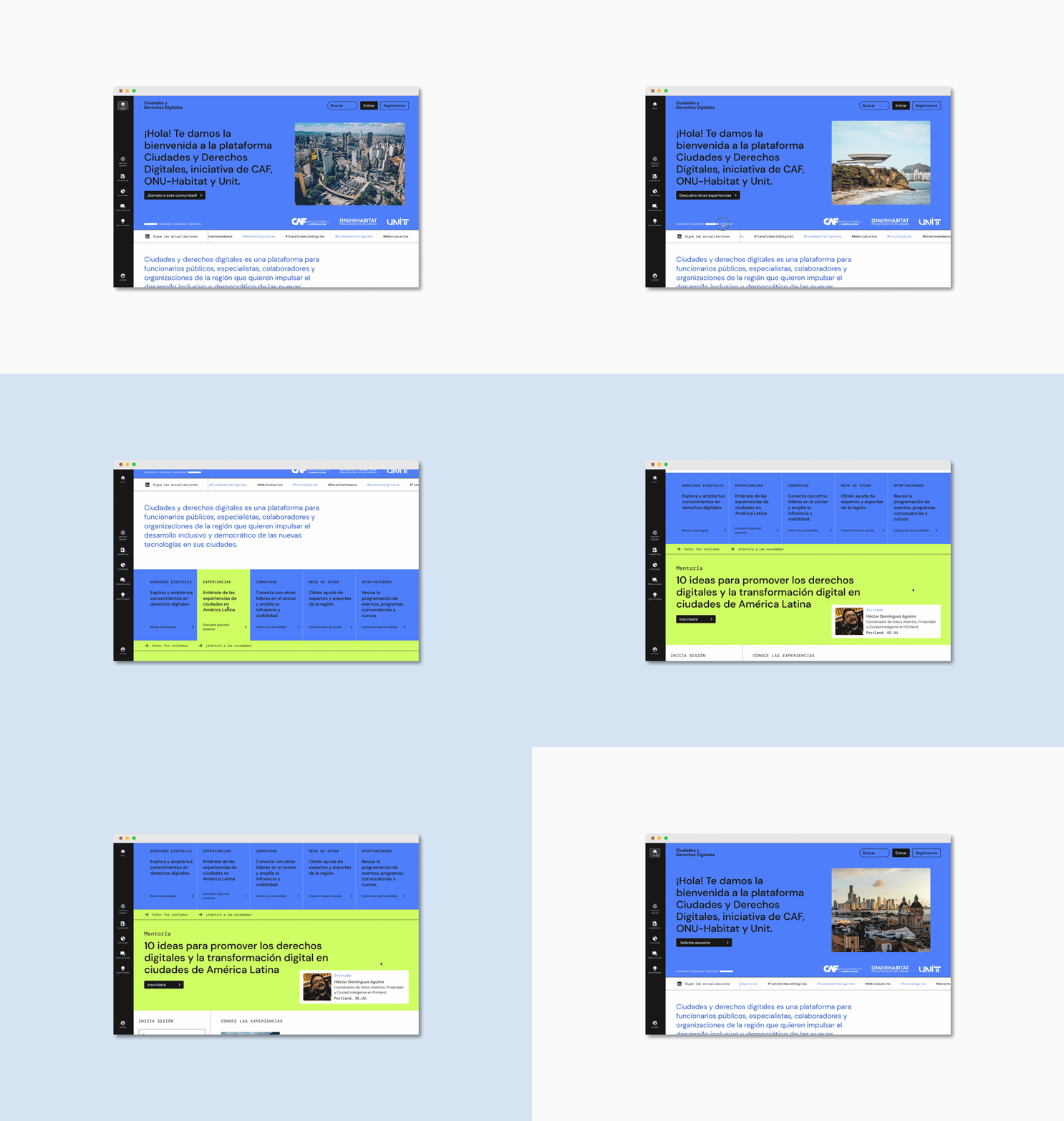
Digital Cities and Rights Platform
36
Latin American cities applied to the regional call for proposals
+100
Public servants participated in the first mentoring cycle
30
Interviews with specialists from the region for the diagnosis
7
Cities participated in co-design and exchange processes (3 Latin American + 4 European)
From Local Tool to Regional Public Good
The project introduced a qualitative change in the way Latin American local governments can address digital transformation. The institutional capacity of participating cities was strengthened to articulate their digital transformation needs in a common rights-based language. Municipal teams moved from working in isolation to becoming part of an international community of practice with access to mentorship, comparative experiences, and methodological resources. A collaborative infrastructure was established that transcends the project cycle, allowing new cities to join the network and access tools calibrated for the Latin American context.
The process also revealed and systematized cross-cutting needs in the region: the importance of strengthening digital transformation teams, creating long-term institutional mechanisms that survive political cycles, building a common language on digital rights, and restoring trust between citizens and public institutions.
The strategic value of this project transcends its specific deliverables and is part of a broader discussion about how Latin America shapes its relationship with technology. In a region where 33% of the urban population lives in poverty and income inequality remains a structural problem, digital transformation cannot be a merely technical exercise. It is a matter of public design that requires placing people—and their rights—at the heart of every decision.
What this project demonstrates is that it is possible to build regional public goods through collaborative innovation processes: a guide that doesn't prescribe universal solutions but offers adaptable frameworks; a platform that not only disseminates content but also enables peer learning; and a community that doesn't depend on a single event but on a sustained collaborative infrastructure. This service design approach applied to digital governance offers a replicable model for other public policy challenges in the region.
The project also helps to close a critical gap: the distance between international legal frameworks on digital rights and the actual capacity of Latin American municipalities to implement them. By translating the complexity of global frameworks into tools applicable to specific municipal contexts, the project sets a precedent for future international cooperation initiatives that seek to strengthen local capacities without imposing standardized models.
The collaboration between CAF, UN-Habitat, the Coalition of Cities for Digital Rights, and UNIT, as methodological orchestrator, establishes a model of intersectoral collaboration that demonstrates how multilateral organizations, public design consultancies, and local governments can work together to produce systemic transformations. At a time when digital agendas are being defined at an accelerated pace, this type of productive ecosystem is essential for Latin American cities to be not only adopters of technology but also active designers of their digital future.
Is your city facing digital transformation challenges?
At UNIT, we design services, governance structures, and tools that put people at the heart of public innovation. If you're looking to integrate a human rights approach into your digitization processes, strengthen institutional capacities, or build collaborative infrastructure among stakeholders, let's talk.
→ Contact UNIT (info@unit.la)