

Publication
Design in public innovation: how design entered the Chilean State through a government lab
Introducing design for policy and innovation in the Chilean public sector through a government laboratory
Nicolás Rebolledo
Founding Partner and Creative & Strategy Director, Public Design UNIT
OCTOBER 19, 2026
Nicolás Rebolledo’s PhD thesis, Design in Public Innovation, submitted at the Royal College of Art, grew out of a concrete experience. In May 2014, the Government of Chile announced the creation of a laboratory to promote an innovative State in the service of people. Nicolás took part in that process in a dual role: as the strategic designer of the Laboratorio de Gobierno, and as a researcher reflecting on that same practice. Over four years, using a methodology he calls “action research through design”, he documented how design was used to create, implement and operate a lab at the highest level of central government.
The question was urgent. By 2016, there were already 65 public innovation labs across EU Member States and 13 in Latin America, most of them working with design methods. Yet research showed their impact was limited. Design tended to remain disconnected from policy processes and power structures, its knowledge carried little legitimacy as evidence, and it struggled to turn the State’s political and organisational factors into matters of design. The thesis responds to this problem with a central argument: design can be integrated into the heart of the State, but only if it stops treating politics as something outside its work.
Designing within politics, not on the sidelines
The Laboratorio de Gobierno was created at the centre of government, where decisions are made under political pressure, on tight timelines and among actors with different interests. There, design could not limit itself to facilitating workshops or prototyping solutions. It had to take part in defining the Laboratorio itself as a policy instrument, negotiate its place with authorities and public services, and prove its value in the same process through which the institution was being built.
From lab to ecosystem
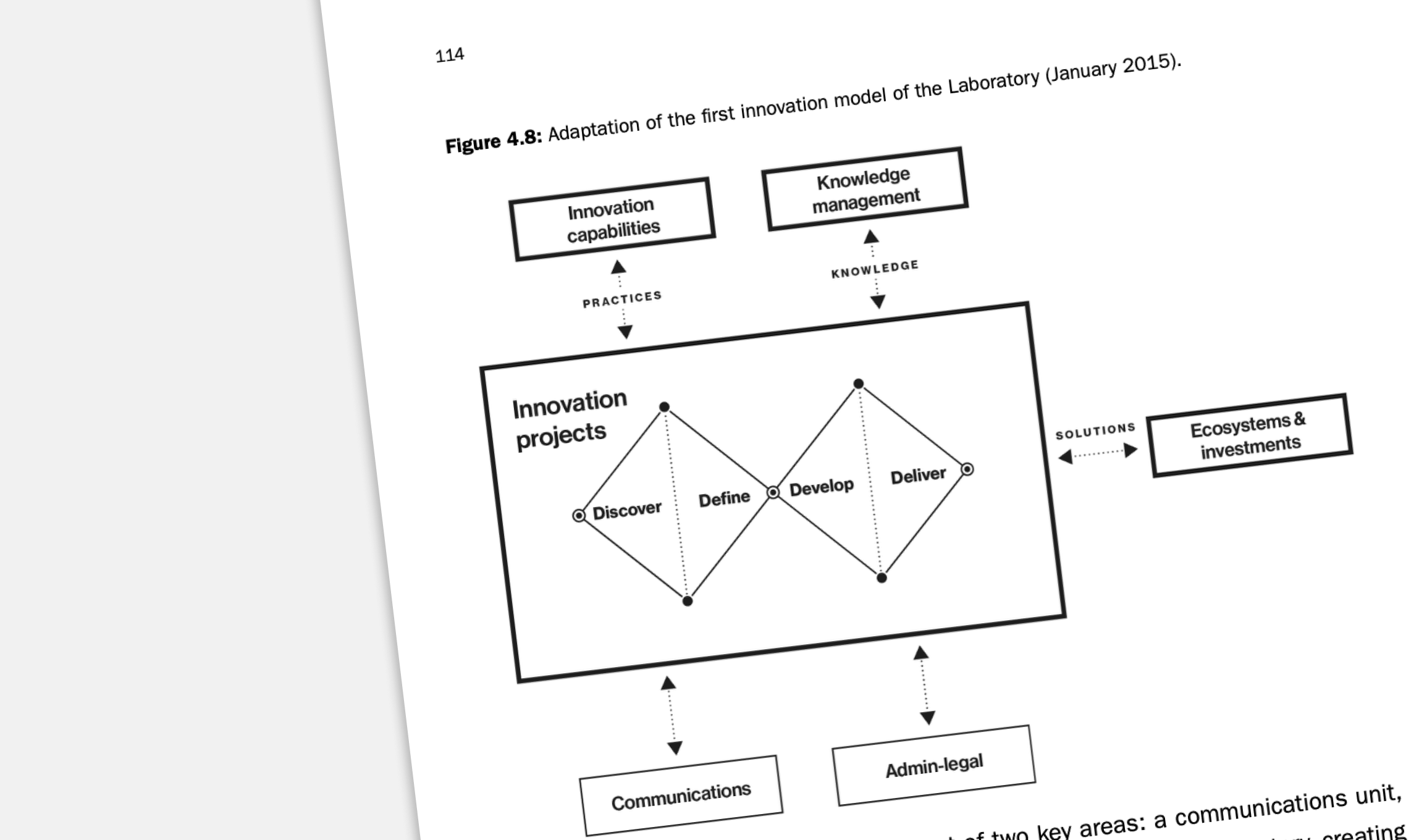
Once the barriers to integration had been overcome, the challenge was to scale. The Laboratorio shifted from developing its own products to offering, as a service, design-led experiences of collaborative innovation. That shift allowed design to reach a much wider part of the public sector, and the Laboratorio gave rise to a public innovation ecosystem that extended beyond the institution itself.
Key takeaways
- Public design is an attitude, not a toolkit. Design had an impact when it was practised as an open, flexible and integrative approach, rather than as the application of a fixed method. That attitude made it possible to treat political and organisational factors (mandates, hierarchies, timelines, interests) as part of what needed to be designed, rather than as obstacles to doing “good design”.
- Design and politics are built together. Legitimacy does not come from good technical results alone. At the Laboratorio, design work and political work moved forward hand in hand, building trust and social capital across sectors. That network of relationships is what made collaboration possible within the State’s real power structures.
- Designing and implementing policy are interdependent activities. The classic model separates policy design from implementation. The thesis shows that, by understanding the policy cycle as adaptive and dynamic, both can work as experimental activities that feed into each other: what is learned through implementation corrects the design, and the design anticipates the challenges of implementation.
- Scaling requires thinking of design as a service. A lab that only develops its own projects reaches few institutions. The Laboratorio broadened its reach when it began offering design-led experiences of collaborative innovation, managed as a service for other agencies. In this way, design stopped being a capability concentrated in one team and began to take root across different parts of the State.
- A lab can become an ecosystem. By consolidating itself as a system of value co-creation, the Laboratorio brought together civil servants, public agencies, universities and design professionals around a shared agenda. Its impact no longer depended only on what the team did, but on the network of public innovators it helped build.
- Design must also learn from the State. Design does not arrive in the public sector ready to use. To work, it had to adapt to the State’s ways of thinking and doing, exploring the cultural practices of civil servants, authorities and other stakeholders with the same attention given to the people who use a service.
The Laboratorio’s legacy
The Laboratorio de Gobierno’s experience became an international reference and inspired similar efforts across the region. Many institutions that worked with the Laboratorio began commissioning service design on their own, which accelerated the growth of that market in Santiago and contributed to the emergence of a service design scene in Latin America. The Universidad de Chile created an executive education certificate in Public Service Design for civil servants and public managers, hosted, tellingly, by its School of Government and Public Management. And the thesis’s lessons shaped the Service Design and Executive Education programmes at the Royal College of Art.
Conclusion
The thesis proposes repositioning design in public innovation, beyond the narrow idea of design thinking: as a legitimate attitude for changing how public problems are framed, as an activity that is not foreign to politics, and as an organisational capability for creating experiences of collaboration at scale. It also leaves a documented body of knowledge (models, processes, frameworks and methods) on how to design and implement an innovation lab within a large public sector system. For UNIT, this experience is also a point of origin: what we learned at the Laboratorio about how design takes root inside the State continues to guide our work today.