

Report
Leading Design Works: the strategic business function of design within regulated industries
Report by the Royal College of Art and EY Studio+
Nicolás Rebolledo
Founding Partner and Creative & Strategy Director, Public Design UNIT
OCTOBER 19, 2026
In just a few years, design has gone from a mainly aesthetic exercise to a central part of how organisations transform. In regulated industries, that shift carries particular weight. Banks, insurers, healthcare providers, energy companies and governments deliver services that are essential to people’s lives, and they do so under strict regulatory frameworks, with high levels of risk and in structures that are not used to integrating a creative discipline. How does design earn a strategic place in that context?
That is the question at the heart of the report Leading Design Works: The strategic business function of design within regulated industries, led by Nicolás Rebolledo in his role as Senior Tutor in Service Design and Head of the Service Futures Studio at the Royal College of Art, in collaboration with EY Seren. The study is based on around 30 in-depth interviews with design leaders in the UK and Europe across financial services, healthcare, government and energy. It starts from the observation that three forces are reshaping these industries: the expectation inflation set by digitally native brands, the digital acceleration brought by the pandemic, and regulation that is increasingly focused on the customer.
Six insights on design as a strategic function
1. Leading design for different and differentiating functions
Design plays many roles within organisations, but it offers two contributions no other function provides in the same way: an end-to-end view of the customer journey, and direct access to customer needs through research and co-creation. The leaders interviewed use both to accelerate change while reducing its risks.
2. Dealing with the changing intentions for design
What an organisation expects from design changes over time: meeting regulation, responding to customers or supporting business objectives. Leaders therefore need a resilient, adaptable design capability that can be deployed from strategy setting through to implementation.
3. Earning the organisational position
This means working in two directions. Upwards, by securing a place at C-suite level, for example through a Chief Design Officer role, which gives the function stability and resources. Downwards, by building teams with enough experience for design to go beyond aesthetics and contribute to strategic outcomes.
4. Creating transformational value
For design to drive systemic change, it must be part of the transformation from the outset rather than confined to a single department. That requires investing in talent, time and training, and explaining design’s contribution in the language of the business.
5. Measuring and communicating value
The leaders who win more room for design are those who measure its contribution using the metrics the organisation already relies on, supplemented with their own data. Linking that contribution to risk reduction and new commercial opportunities is what gives them permission to go further.
6. Building an integrated design culture
Design culture is intangible but decisive: it eases design’s integration into the business and helps attract and retain talent. The challenge is twofold, because it has to be nurtured within design teams while also being embraced by the wider organisation.
What’s next for design leadership
The leaders interviewed identify three agendas for change. First, human-centred design is changing how organisations relate to regulation: no longer just an obligation to meet, but a space for collaboration with regulators. Second, artificial intelligence is changing the very materials of design, pushing teams to ask new questions and take on new responsibilities. Third, customer experience ethics will become the great differentiator in the eyes of both consumers and regulators.
Key ideas
- Design is no longer just aesthetic: in regulated industries, its value lies in accelerating change while reducing its risks.
- Position has to be earned: design needs backing at C-suite level, experienced teams and the ability to express its value in the language of the business.
- More responsibility, not just more influence: with AI, the ethics of services becomes a central part of design work.
Conclusion
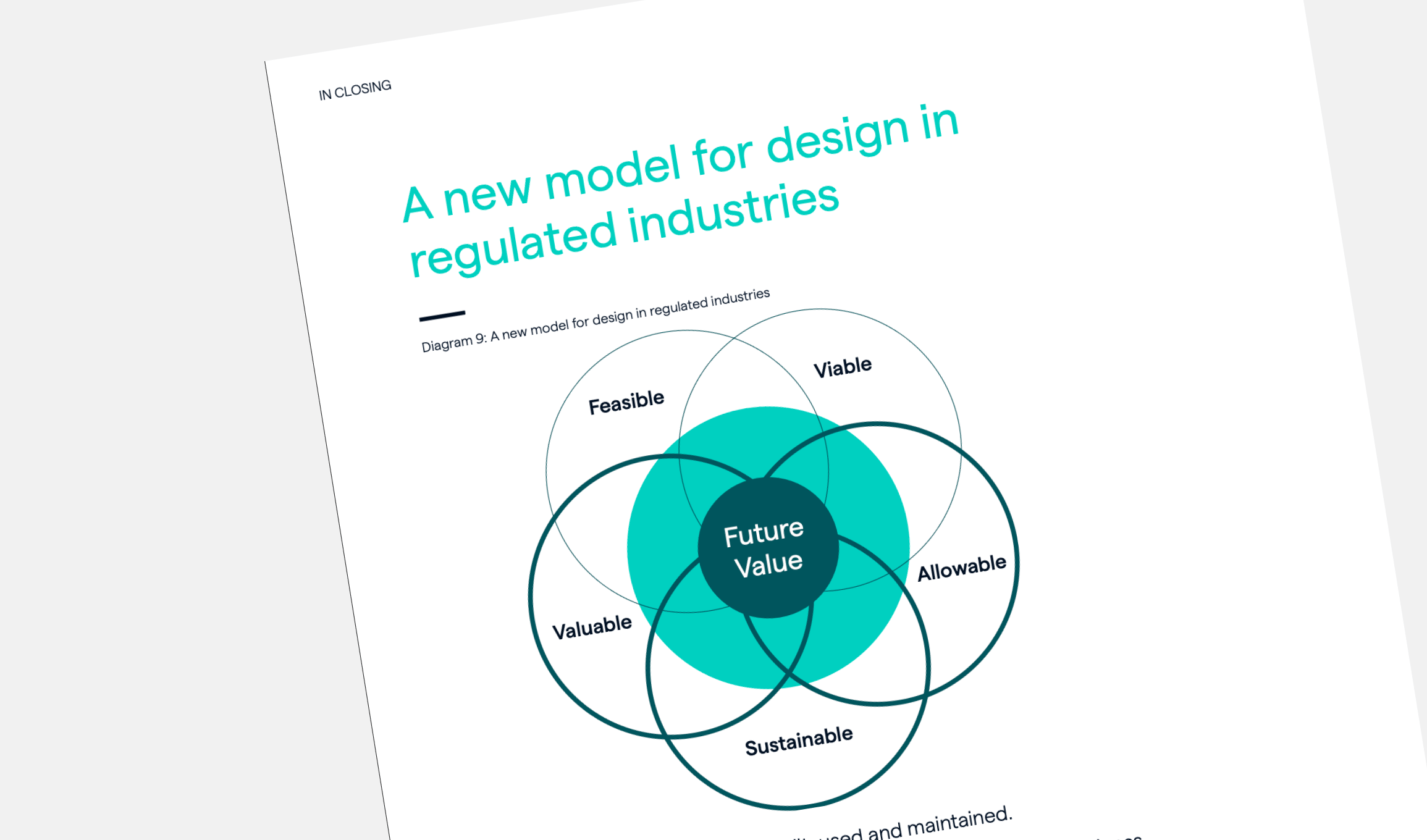
These organisations design services that keep people warm through the winter, look after their savings, care for them when they are ill and support them when they are in need. In this context, the stakes are high, and design carries an ethical responsibility. That is why the report proposes revisiting the classic design thinking model, which places design’s contribution at the intersection of desirable, feasible and viable. Desirability is not enough: people sometimes want things that go against their own interests. The new model adds three dimensions. The service should be valuable, creating real benefit beyond the desire to consume. It should be allowable, serving people better within regulatory limits and even improving on them. And it should be sustainable, with a positive impact on the environment and society. That is the challenge for those leading design today.
The report was written by Nicolás Rebolledo, John Makepeace, Monica Henderson and Brando Guerreri, of the Service Futures Studio at the Royal College of Art, together with Peter Neufeld and Will Shaw of EY Seren.