

Publication
The value of design in policymaking
Chapter for the Service Design Impact Report: Service Design Network (2016)
Nicolás Rebolledo
Founding Partner and Creative & Strategy Director, Public Design UNIT
OCTOBER 19, 2026
In “The value of design in policymaking”, Nicolás Rebolledo asks two questions: why governments need to innovate, and how service design can help them transform the way they make policy and design public services. Written in 2016, while he was an academic at the Royal College of Art, completing his PhD and leading the Design for Policy Platform there, the text offers an early reading of a debate that remains open today: what place design can hold at the heart of government action.
The chapter is part of the Service Design Impact Report: Public Sector, published in October 2016 by the Service Design Network (SDN), the international service design network led by its president Birgit Mager, who was also the report’s editor-in-chief. With support from the Netherlands Enterprise Agency (RVO), the report brought together leading voices in public sector design, including Cat Drew of the UK government’s Policy Lab, Lou Downe, then Head of Design for the UK government, Jesper Christiansen of Nesta, and Joyce Yee of Northumbria University. It also included a survey of practitioners from different countries, in which 47% said design was already on their country’s policymaking agenda. Nicolás’s text opens the section dedicated to design for policy.
Why governments need to innovate
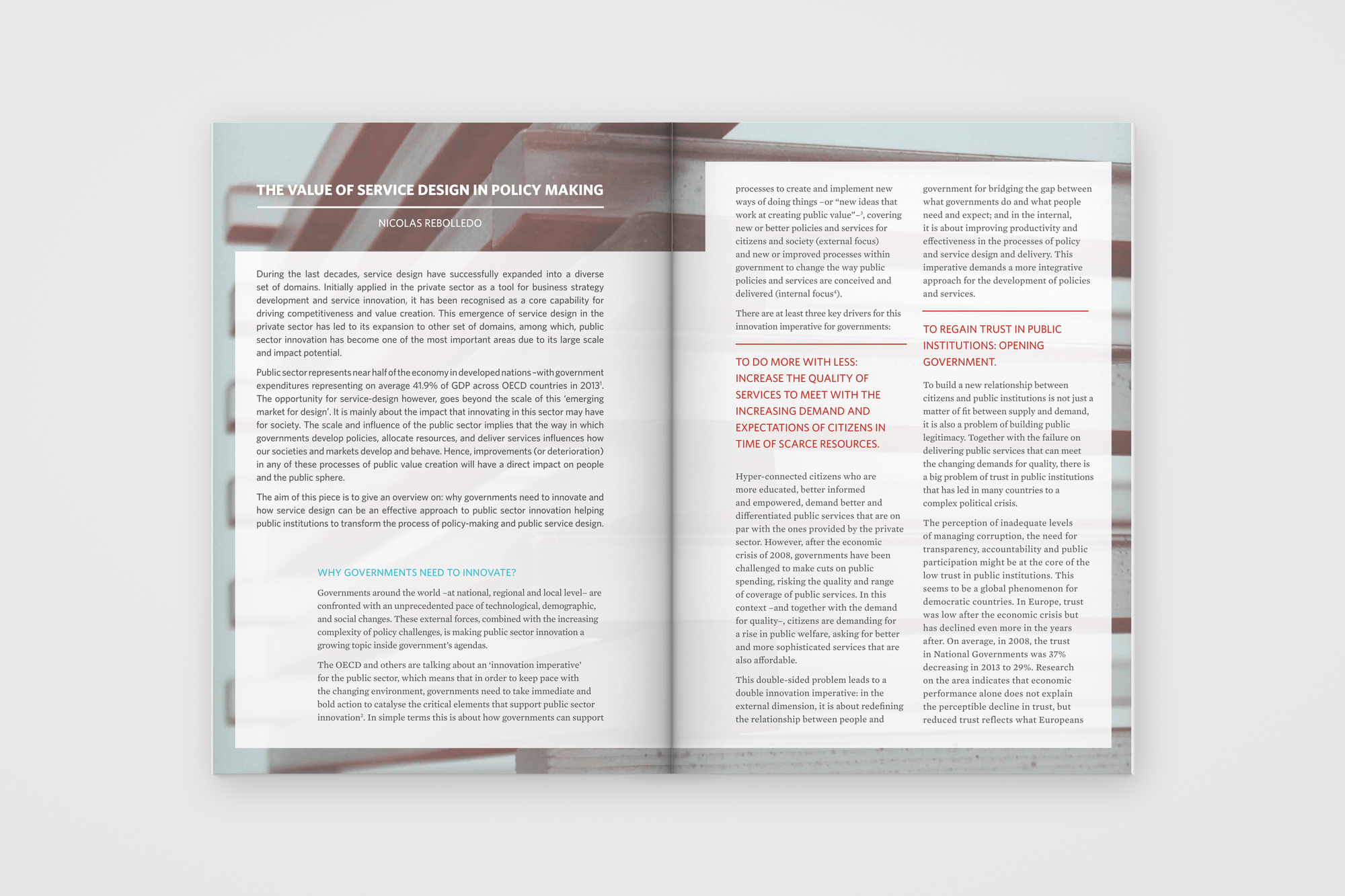
The public sector accounts for nearly half the economy in developed countries: in 2013, government spending averaged 41.9% of GDP across OECD countries. But beyond its size, what matters is its influence: how governments make policy, allocate resources and deliver services shapes how societies develop. The chapter identifies three drivers of what the OECD calls the public sector’s “innovation imperative”:
- Doing more with less. Better-informed, more connected citizens expect higher-quality services, while budgets have been squeezed since the 2008 crisis.
- Regaining trust in institutions. In Europe, trust in national governments fell from 37% in 2008 to 29% in 2013, calling for more open government, with greater transparency, participation and inclusive governance models.
- Dealing with the complexity of public problems. Challenges such as an ageing population or climate change cannot be solved with traditional linear approaches, and require a systemic, relational view.
Design as part of policy, not just its implementation
Public policies are themselves design outcomes, the chapter argues, building on the work of Christian Bason and Sabine Junginger. Yet design is usually treated as a tool for the implementation stage, once the problem has already been defined. The work of public innovation labs shows another possibility: bringing policy formulation and implementation together into a single design process. The chapter describes this as a progression, from design as a new capability, through the design of service interactions and service systems, to design for policy, where impact shifts from discrete change to systemic change.
Key takeaways
- Putting people at the centre of problems and solutions. Design shifts the focus of policy from a supply-driven logic to people’s needs. It combines data with ethnographic research, adds a bottom-up perspective to the traditional top-down approach, and turns citizens into co-creators of services and policies.
- Experimenting to make better decisions. While traditional policymaking starts from norms and present-day facts, design proposes possible futures through prototyping and testing. As Matthew Taylor of the RSA has warned, governments often work like big publishing houses, producing laws and reports rather than solutions. Experimentation speeds up learning between what a policy sets out and what actually happens on the ground, and allows bad ideas to be dropped before they become political problems.
- An alternative language for communication. Where policy works with words and facts, design works with stories and images. Visualising problems, scenarios and experiences helps teams spot opportunities, communicate their proposals more effectively, and align service providers with the policy’s objectives.
The potential of service design in this field can only be realised if it is seen as a supporting feature of public action, and not as a replacement for it.