

Publication
An innovative State for people: the early years of Chile’s Laboratorio de Gobierno
Report detailing the first iteration of the Government Laboratory of Chile, 2014–2018
Juan Felipe López · Nicolás Rebolledo · Katalina Papic
Partners, Public Design UNIT
OCTOBER 21, 2026
In March 2018, at the close of its first phase, Chile’s Laboratorio de Gobierno published Un Estado innovador para las personas: los primeros años del Laboratorio de Gobierno, 2014-2018 (An innovative State for people: the early years of the Laboratorio de Gobierno, 2014–2018). The book documents how the first national-level public innovation lab in Latin America was created and how it worked, drawing on more than 80 interviews with civil servants, entrepreneurs and collaborators. It includes forewords by President Michelle Bachelet, Geoff Mulgan (then CEO of Nesta), Claudio Muñoz (Telefónica) and Esperanza Cueto (Comunidad Mujer), and offers a detailed account of the projects, programmes and people that shaped the institution. It is available under a Creative Commons licence.
For UNIT, this book is part of our own history. UNIT’s founders were central to the creation and operation of the Laboratorio, and Juan Felipe López served as its Executive Director during those early years.
Creating the Lab as a design problem
In her annual address to the nation on 21 May 2014, President Bachelet announced the creation of the Laboratorio de Gobierno with a clear mandate: to go beyond modernisation and promote an innovative State in the service of people. As she notes in her foreword, the aim was not to innovate out of a technocratic drive for efficiency, but because democracy demands that the State build its legitimacy through the services it provides to citizens.
Proposals to design the new institution came from organisations such as NYU GovLab, MindLab and Universidad Adolfo Ibáñez. Ours, led by Nicolás Rebolledo and Juan Felipe López, was selected, and we took on the task of building the initial team and creating the Lab’s strategy. The starting point was to treat the laboratory itself as a design problem: first understanding who its users would be (citizens, civil servants, authorities, entrepreneurs, academia and students) and what they needed. Between September and December 2014, the team reached out to more than a hundred institutions to map the ecosystem, prototyped the Lab’s work at a primary healthcare centre in Recoleta and, based on that test, defined the profiles for the first multidisciplinary team, selected from 2,758 applicants.
Institutional design was also key. The Lab was set up as a committee of CORFO, Chile’s economic development agency, which gave it autonomy and flexibility, and was placed under the direction of an inter-ministerial strategic council. This structure allowed it to act as a bridge between ministries, public services and actors outside the State.
A model for innovating through collaboration
The Laboratorio de Gobierno’s mission was to develop, coordinate, facilitate and promote open innovation processes that were people-centred and grounded in collaboration. To achieve this, a model was developed around three mutually reinforcing functions. The foundation is connecting and mobilising: building an ecosystem of actors able to collaborate around public innovation agendas, whose main asset is social capital across sectors. On that foundation comes building capabilities: developing the skills, motivation and opportunities for civil servants to innovate within their own institutions. Finally, exploring and solving: creating, testing and implementing solutions to high-impact public problems.
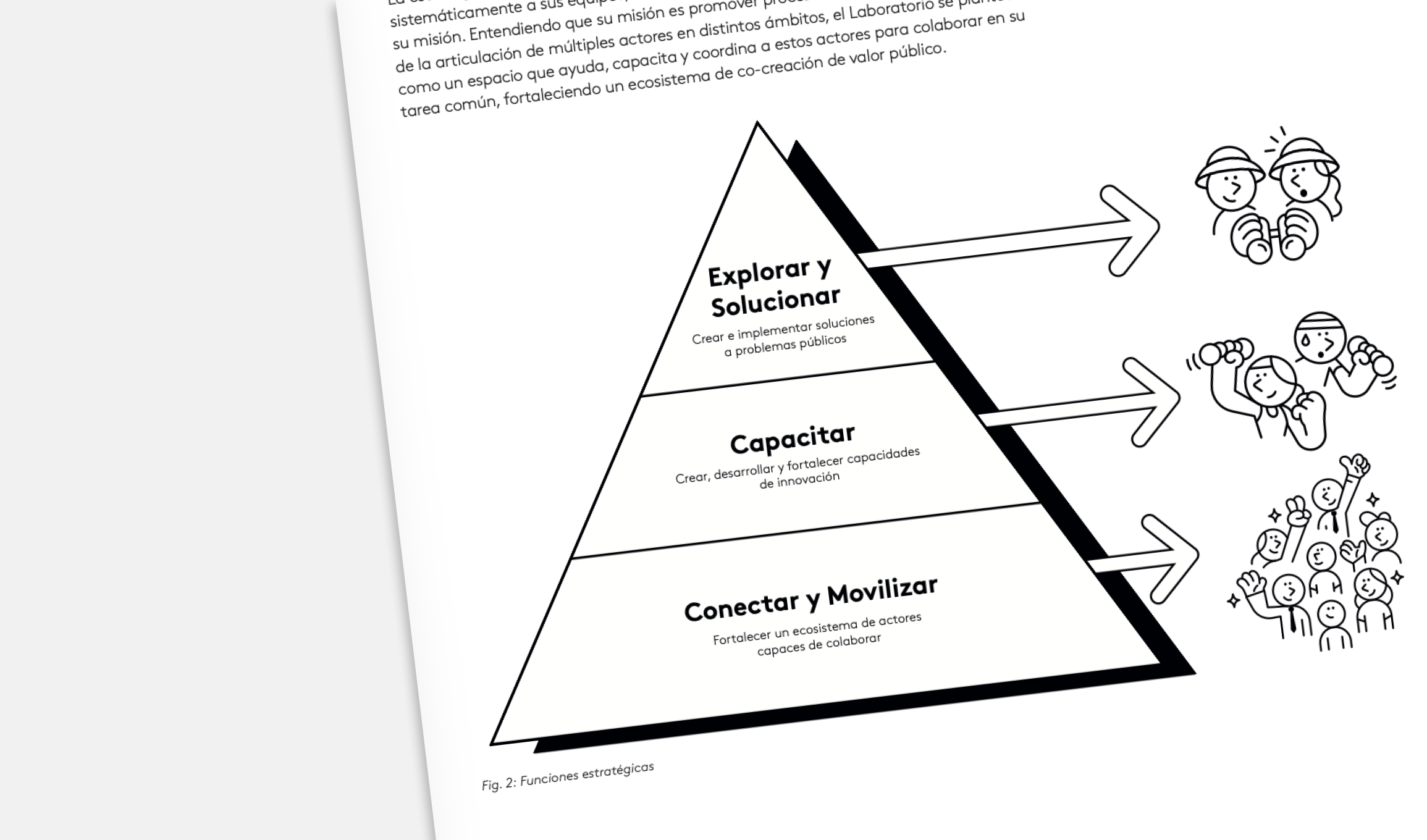
The Lab’s way of working rested on five principles: a focus on people, co-creation, systems thinking, experimentation and a focus on experience. Its methodology combined design-led innovation with tools from entrepreneurship, open innovation and experiential learning. Just as important as the method was the space: it was conceived as a place to experiment with controlled risk, something unusual in a public sector culture that tends to penalise error.
This model translated into a portfolio of programmes for different types of problems. Flexible projects tackled sensitive challenges alongside each institution, using service design and co-creation. One of them was the redesign of electricity and gas bills, co-created with residents and adopted by 42 companies, benefiting more than 7.5 million households. The open innovation programmes, Impacta and AULAB, invited entrepreneurs, students and academics to tackle public challenges in health, energy, public safety, natural disasters and tourism. Experimenta trained teams of civil servants through real projects within their institutions: 12 institutions took part in its first edition and 21 in its second, across Santiago, Concepción and Puerto Montt. And a programme of ecosystem support included the Public Innovators Network, the Funciona! award and international partnerships such as Futuro Latino and States of Change.
The results of this work fall into three categories: concrete solutions to public problems, such as prototypes and pilots; systematised knowledge that informs policy design, such as the study of ChileAtiende from its users’ perspective; and practices and capabilities embedded in participating institutions. In almost four years, more than 9,800 people proposed solutions to public challenges, more than 114 solutions were incubated, 29 pilots were launched and 9 new services began operating nationwide. The Public Innovators Network grew to more than 3,200 civil servants from all 15 regions of the country, representing 424 institutions.

Seven lessons from these years
The book closes with seven reflections, drawn from the collective work of those years, on how to make this effort sustainable and increasingly widespread:
- Public innovation does not belong to the State alone. Better solutions to public problems require the involvement of civil society, academia, students, businesses, trade associations, entrepreneurs and citizens. The Chilean State has a long tradition of modernisation, but its best cases have emerged when different actors come together in search of solutions. Opening up the State is not a concession, but a condition for innovation.
- Innovation does not happen in the abstract. Innovation is a means of solving problems and asking new questions, not an end in itself. Capability building should therefore be grounded in real problems and concrete projects, not theoretical exercises. And public innovation should be put to work on the structural issues where clear answers are still lacking.
- Conflict should be managed, not avoided. Every project needs diverse strategic partners, willing to challenge each other’s views on a policy in a horizontal and transparent space. Far from being an obstacle, this meeting of different perspectives is what makes solutions sustainable, because it makes them more robust and more legitimate.
- Design complements public management. Design methods and visual thinking make public management more efficient and better connected to people’s needs. The State has always worked with words and data, but people work with stories and images. Combining all four to think about, design and deliver new services proved to be an effective model.
- Complexity needs institutions that bring people together. Today’s public problems involve many actors with different interests, and none of them can solve these problems alone. One of the Laboratorio’s main roles was to open a space for dialogue and encounter, managing conversations and partnerships to develop effective solutions.
- Every innovation needs an institutional owner. The public-private ecosystem often generates good solutions, but there is no one to turn them into standardised services at scale. For an innovation to have real impact, an institution must take responsibility for implementing, evaluating and scaling it.
- Public innovation creates pride in working for the State. When teams embark on innovation processes and projects, the culture and morale of institutions change. That pride is something no other management process achieves, and without it, it is impossible to create more creative, efficient and productive environments.
What the lab kickstarted
At UNIT, the lab is where our work began. There we learned that innovating in the State is not a technical matter, but a way of rebuilding trust between institutions and the people they serve. That design does not arrive at the end to give shape to decisions already made, but can sit at the heart of how public policies are conceived and built. None of this lasts without committed people, inside and outside the State, willing to work together.
These convictions still drive us. For many of us, the Lab was the first proof that another way of managing public affairs was possible. Since then, we have taken that experience to governments and institutions in different countries, and we have also learned from its limits.