

Article
How innovation teams earn (or lose) their seat at the table
Why positioning matters more than talent, methodology or budget.
Juan Felipe López
Founding Partner and Executive Director, Public Design UNIT
OCTOBER 21, 2026
Juan Felipe López published a column in Bloomberg Cities’ The Forum on a question he has been thinking about for a long time: why some public innovation teams become indispensable to their cities, while others, sometimes the ones launched with the highest expectations, end up fading away.
The column was also shared through Spark, the Bloomberg Cities newsletter. Backed by Bloomberg Philanthropies and the Bloomberg Center for Public Innovation at Johns Hopkins, Bloomberg Cities is one of the leading platforms for mayors and innovation teams around the world. It is behind initiatives such as the Mayors Challenge and the network of city innovation teams (i-teams).
An ecosystem that found its shape
A little over a decade ago, public innovation was still working out what it could be. Denmark’s MindLab was at its peak, while Helsinki Design Lab was winding down. Organisations such as La 27e Région in France, The Lab at OPM in the United States, MaRS Solutions Lab in Toronto and Nesta in the UK were leading the way. At the same time, Bloomberg Philanthropies was beginning to fund a generation of innovation teams in cities. It was new and promising, but it was not yet clear what place these teams would hold within government.
Today the pattern is clearer. Some teams have become indispensable: leaders call them first and departments bring them in for the hardest problems. Others are still on the org chart, producing reports and running workshops, but they are no longer who people turn to when something really matters. Having helped build Chile’s Laboratorio de Gobierno, the first national-level public innovation lab in Latin America, and having worked with 150 national, subnational and local governments, Juan Felipe’s conclusion is clear: the difference is almost never talent. It is positioning, that is, where a team actually sits within the structure of power.
The three sources of positioning
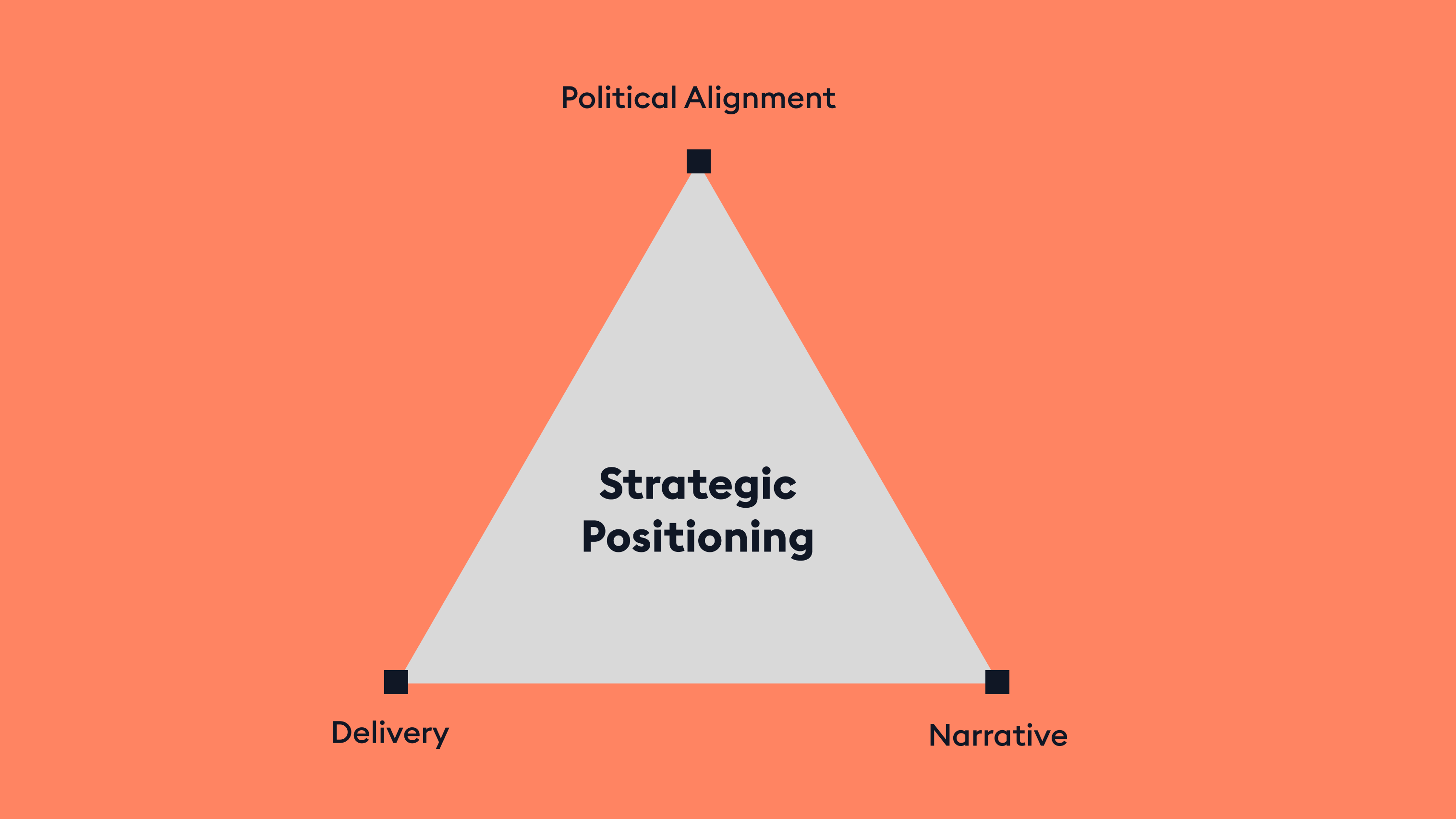
Positioning cannot be decreed; it is built from three elements that must work together.
The first is political alignment: a real connection between the political authority, the team’s technical leadership and the stakeholders around it. Innovation teams know how to apply service design outwards, towards citizens, but rarely inwards and upwards. Reading the aspirations and interests of decision-makers with the same rigour as a user interview is not cynicism; it is craft, applied where it is least often used.
The second is narrative. Many outstanding teams have lost their place simply because they couldn’t explain, in plain language, what they do and why it matters. Communication is not propaganda, but infrastructure for keeping new ways of working in place over time. A team that doesn’t tell its own story ends up having it told by others, usually by those who want its budget.
The third is delivery. A narrative without results is hollow, and it erodes credibility faster than silence. Political backing without delivery produces speeches that improve while the city doesn’t. Delivery without political backing produces good pilots that nobody scales. What lasts is the combination of all three.
Why some teams fade away
Teams that lose ground usually do so without realising it. They start following opportunities rather than purpose, taking on whichever problem brings funding or visibility, not the one the city most needs to solve. Over time, they drift away from leadership’s priorities and from the core of government. When a new administration arrives, no one is willing to defend them, because no one can easily explain their value.
To avoid this, the column offers leaders four keys. Anchor the team in the problems that truly keep them up at night. Give it an explicit mandate. Build coalitions that connect the front line with government decision-making. And demand political alignment, narrative and delivery, all at the same time.
A conversation that is only now possible
This question is not new to us. Much of what we do at Public Design UNIT, and of what we spent years building at Laboratorio de Gobierno and States of Change, has been about reflecting on how public innovation earns, or loses, its seat at the table. What is new is that we can now talk about it openly. For a long time, power was almost taboo in the field: we talked about human-centred design and prototypes, but rarely about the fact that none of it works without a connection to political authority. More than a decade of labs opening and closing has produced enough evidence to say this without cynicism. The fact that this discussion now has a place in an outlet like Spark is itself a sign that the ecosystem has matured.
The column also sparked a debate worth continuing. After it was published, several people challenged the idea that talent matters less than positioning: shouldn’t a talented team be able to read power and build its own legitimacy? In a follow-up piece, Juan Felipe explores how talent depends on the context that sustains it. Perhaps positioning doesn’t replace talent, but rather amplifies or wastes it. The question remains open: is the ability to read power and translate it into narrative a form of talent, or is it already an expression of positioning?