

Publication
Remaking public innovation practice: three shifts
Chapter for Creative Bureaucracy: Where Next & How?, the first Global Report of the Creative Bureaucracy Festival
Juan Felipe López · Nicolás Rebolledo
Founding Partners, Public Design UNIT
OCTOBER 21, 2026
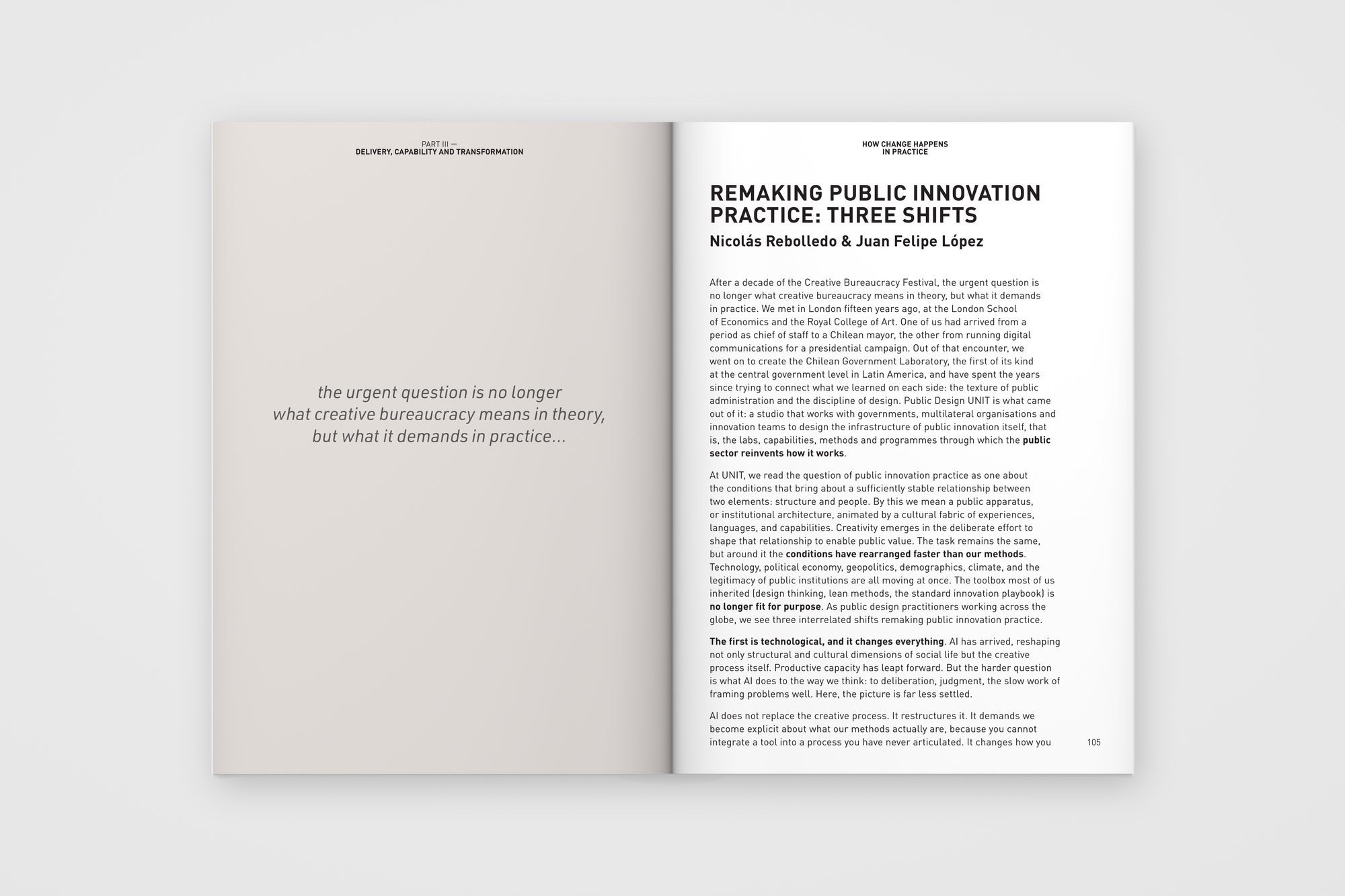
Charles Landry invited us to contribute an essay to the first Global Report of the Creative Bureaucracy Festival, Creative Bureaucracy: Where Next & How?, co-edited with Sebastian Turner and published by Falling Walls Press. The result is “Remaking Public Innovation Practice: Three Shifts”, written by Juan Felipe López and Nicolás Rebolledo from UNIT.
The chapter draws on more than a decade of public design practice, which at UNIT we understand as the political, situated and collaborative practice of using design (its methods, sensibilities and imagination) to address public challenges. In 2014, we helped create Chile’s Laboratorio de Gobierno, the first lab of its kind at central government level in Latin America, and what we learned there about how design takes root inside the State is, in large part, where UNIT began. Since then, we have worked with national and local governments, multilateral banks, foundations and innovation teams in Latin America, Europe and North America. Almost always on the same task: designing the infrastructure of public innovation, that is, the labs, capabilities, methods and programmes through which the public sector reinvents how it works.
Along the way, we have seen public design grow from an emerging practice into a field with its own vocabulary, teams and institutions. But we have also seen the ground move faster than our methods. The chapter proposes reading that movement along three axes.
Three shifts
The first is technological. Artificial intelligence does not replace the creative process; it restructures it, changing how we frame problems, synthesise research and produce prototypes. This forces us to make our methods explicit, because you cannot integrate a tool into a process that has never been articulated.
The second is cultural. The toolkit of innovation methods, largely born in the Global North, needs to be situated to work in contexts where much of social and economic life is informal. Latin America also has a long tradition of participatory design and popular planning to contribute. Methods that travel without translation fail.
The third is political. At a time when democratic institutions are being called into question, deliberation is not friction to be bypassed, but the condition for innovation worth having. That is the chapter’s through-line: we believe in a democratic answer to public innovation, not a technocratic shortcut around it. Creative bureaucracy, as we see it, is the practice of keeping a society’s democratic muscle at work.
A global conversation
The book brings together voices such as Geoff Mulgan, Mariana Mazzucato, James Anderson, Christian Bason, Indy Johar, Piret Tõnurist, Gabriella Gómez-Mont and Rainer Kattel, in a conversation about how states can become more imaginative, capable and human in turbulent times. We thank Charles Landry and Sebastian Turner for sustaining, over more than a decade, a space where “creative bureaucracy” stopped being an oxymoron and became a way of working.
Read the publication in English here. We will soon publish our Spanish translation of the report.