
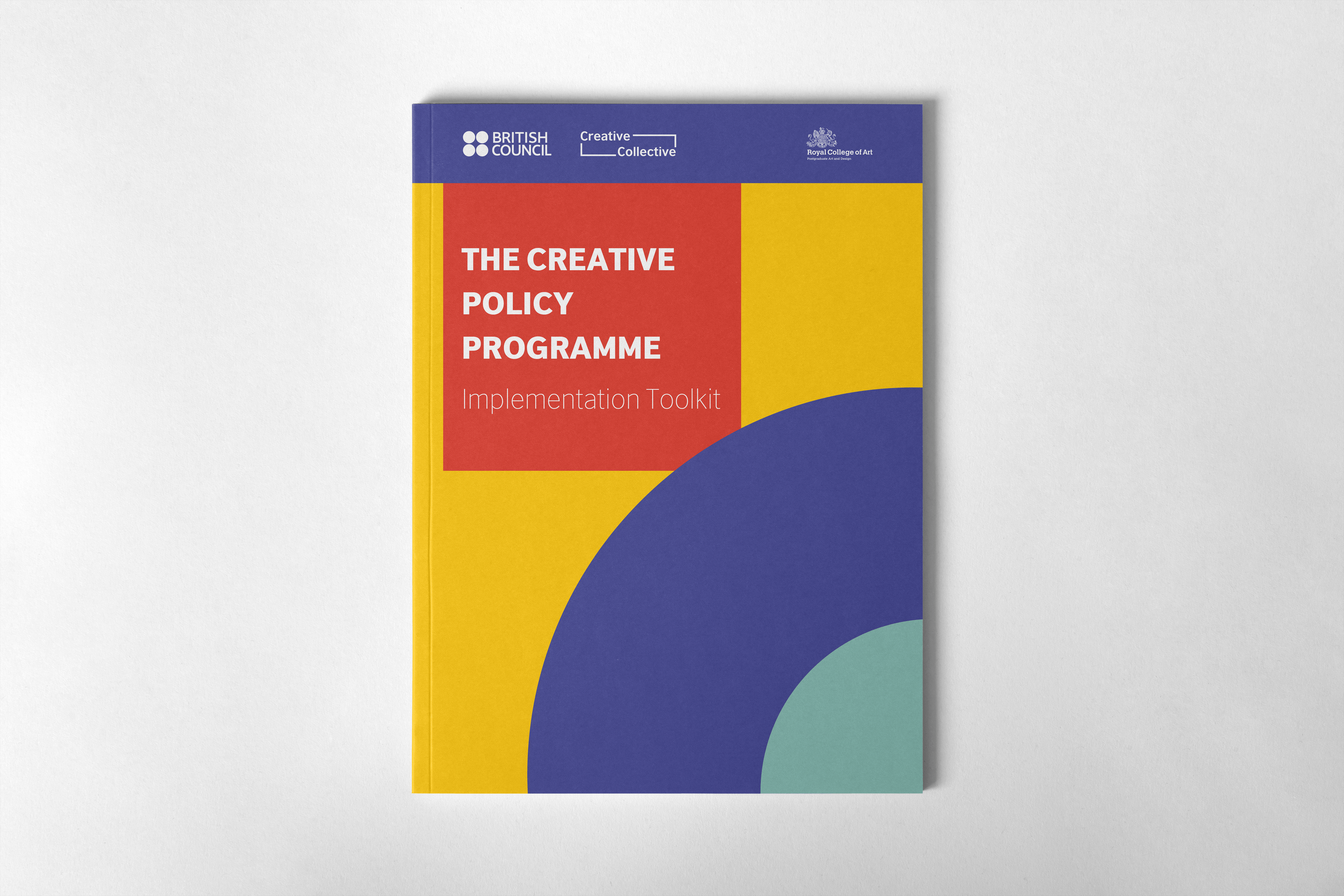
The Creative Policy Programme — Implementation Toolkit
APRIL 22, 2026
AUTOR
FECHA
IDIOMA
Context
The creative economy represents a growing force for sustainable development across Latin America, yet public policies to support the sector often lack the design-driven perspective needed to address its unique challenges. In Mexico, the Federal Ministry of Culture had been advancing efforts to strengthen the creative and cultural industries, recognizing their contribution to economic growth, social cohesion, and cultural diversity. Against this backdrop, the British Council's Creative Collective initiative and the Royal College of Art's programmes sought to bridge the gap between design thinking and cultural policy through an applied, capacity-building approach.
Challenge
Despite increasing recognition of the creative economy's potential, policymakers in the cultural sector often lack practical tools to translate broad strategic goals into effective, user-centred policies. Traditional policy development processes tend to be top-down and siloed, failing to incorporate the perspectives of diverse stakeholders — from artists and cultural entrepreneurs to community organisations and local governments. There was a need for a structured, replicable programme that could equip public servants with design methodologies to co-create policies that respond to the real needs of the creative ecosystem.
Approach & Methodology
The Creative Policy Programme was developed as a five-day intensive workshop grounded in the Double Diamond design process. UNIT's principal consultant designed and facilitated the programme across six modules: Briefing, Introduction to the creative economy landscape, Exploring the Problem through stakeholder mapping and research, Designing a Proposition using prototyping and co-design techniques, Presentations of policy proposals, and Evaluation. The first implementation took place in July 2019 with the Cultural Development Division of Mexico's Federal Ministry of Culture, convening 24 registered participants — policy officers, programme managers, and cultural promoters — working in multidisciplinary teams.
Key Findings & Results
The programme produced four policy propositions addressing access and accessibility, capabilities and professionalisation, cultural richness, and models for sustainability in the creative economy. Of 24 registered participants, 22 actively participated and 20 completed the full programme. Evaluation results showed that 81% of participants strongly agreed on the programme's relevance and 69% on having acquired new capabilities. Top learning outcomes included stakeholder mapping, problem definition, incorporation of multiple perspectives, and brainstorming techniques.
Significance & Implications
This toolkit represents a pioneering effort to embed service design methodologies within cultural policy development in Latin America. Its modular and scalable structure allows adaptation to different institutional contexts, making it a valuable resource for any government agency seeking to adopt design-led approaches to policy in the creative and cultural sectors.
Key Takeaways
- Design-led policy workshops can equip public servants with practical tools to co-create user-centred cultural policies.
- The Double Diamond process provides an effective structure for translating broad strategic goals into actionable policy propositions.
- Multidisciplinary team composition — mixing policy officers, programme managers, and cultural promoters — enriches the quality of policy outcomes.
- A modular toolkit format enables replication and adaptation across different institutional and geographic contexts.
- Evaluation results confirm strong participant engagement and measurable capability-building in design-driven policy methods.