
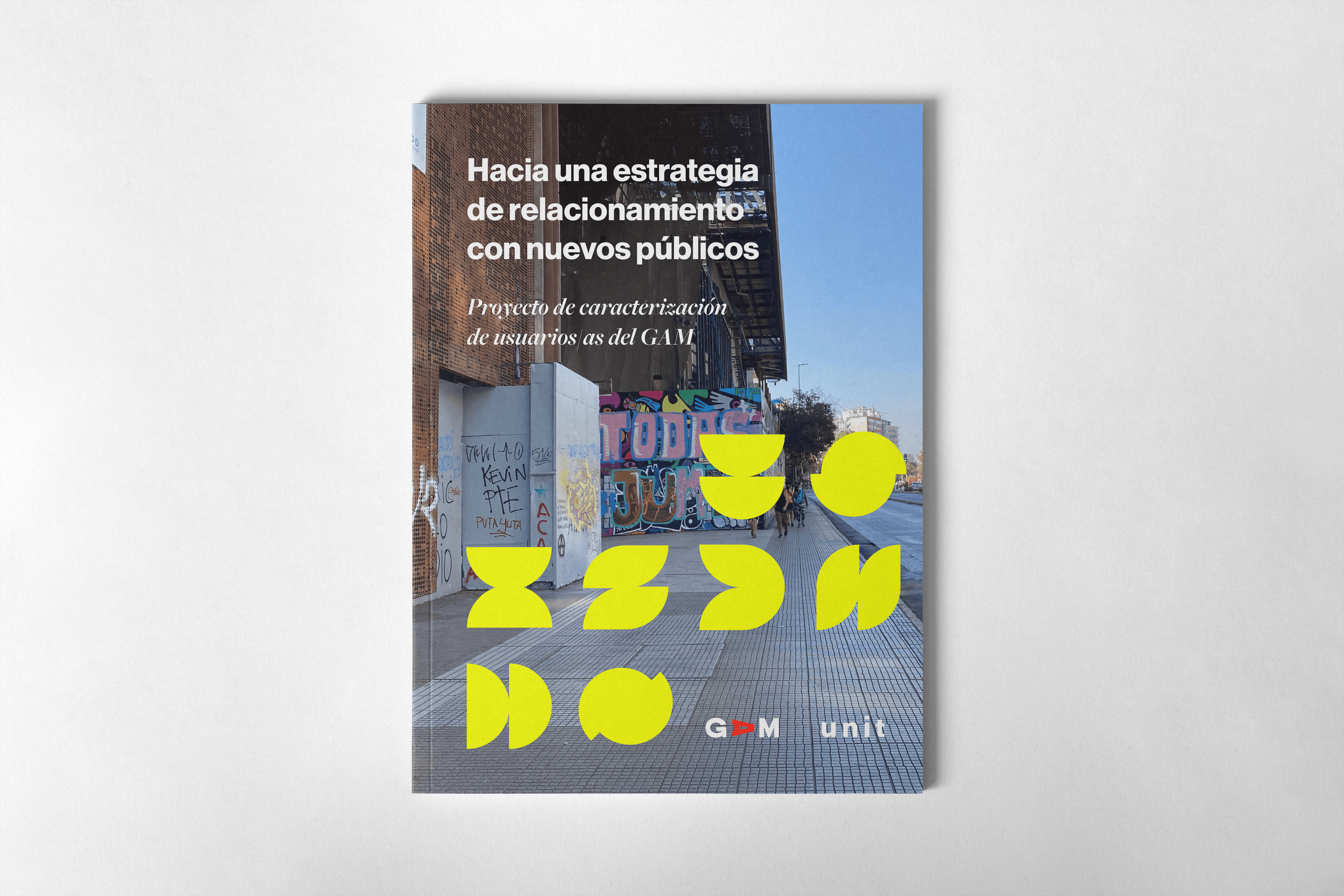
Towards an Audience Engagement Strategy
APRIL 22, 2026
AUTOR
FECHA
IDIOMA
Context
The Gabriela Mistral Cultural Centre (GAM) is one of Chile's most important cultural venues, located in the heart of Santiago. After years marked by the 2019 social unrest and the COVID-19 pandemic, GAM faced a transformed landscape: cultural consumption habits had changed, new audiences had emerged in its spaces, and the relationship between the centre and its community needed rethinking. In this context, GAM sought to understand in depth who its users were, how they experienced the space, and what expectations they had — with the aim of building an evidence-based engagement strategy.
Challenge
GAM lacked an updated characterisation of its audiences reflecting the changes brought about by the social and health crises. Existing communication mechanisms had significant gaps: programming did not reach all user segments effectively, signage and navigation within the space were insufficient, digital interaction was limited, and staff served as the only effective information touchpoint. Without a granular understanding of different user profiles and their specific needs, GAM could not design differentiated engagement and programming strategies.
Approach & Methodology
UNIT developed the project using a service design methodology structured across seven research stages. The process included analysis of 32 institutional documents, 31 semi-structured interviews with internal and external stakeholders, 3 field observation sessions, 11 in-depth user interviews, and a benchmarking exercise covering 17 international cultural organisations. Fieldwork was conducted between January and May 2022, combining qualitative ethnographic research techniques with institutional data analysis to build a comprehensive picture of the GAM audience experience.
Key Findings & Results
The research identified 8 user profiles organised into 4 categories based on their relationship with the space: GAM as public square (Creative Communities and Habitual Visitors), GAM as cultural destination (Occasional Visitors, Historical Neighbours, and Families on an outing), GAM as workspace (GAM Artists and Remote Workers), and GAM as artistic venue (Classical Audience). Based on these profiles, the project formulated 6 strategic objectives, 19 specific objectives, and 6 action recommendations. Findings revealed critical gaps in programming communication, spatial navigation, and digital interaction.
Significance & Implications
This project is a benchmark in applying service design to cultural institution management in Latin America. The audience characterisation methodology — based on users' relationship with the space rather than demographic variables — offers a replicable model for cultural centres seeking to strengthen their connection with diverse communities in contexts of social transformation.
Key Takeaways
- Audience profiling based on users' relationship with the space — rather than demographic data — enables more effective engagement strategies.
- The 8 GAM user profiles reveal that the centre simultaneously functions as a public square, cultural destination, workspace, and artistic venue.
- Communication and information gaps are the primary obstacle to connecting GAM's programming with its diverse audiences.
- Benchmarking 17 international cultural organisations provides concrete references for modernising the institutional engagement strategy.
- A service design methodology with multiple evidence sources enables the development of people-centred cultural strategies.