
Developing Design Capabilities in Public Servants to Transform Cultural Policy
In tandem with the British Council Mexico and the Royal College of Art, UNIT developed a capacity-building programme for Mexican public servants —introducing service design methodologies into the cultural sector to strengthen the ability of government teams to develop human-centred policies and programmes.
Cultural Policy: Designed for vs with People
Mexico’s creative economy is one of the most complex in Latin America: a network of cultural industries, artisan sectors, audiovisual production, and heritage-based enterprises that employs millions and shapes the country’s global identity. Yet the public servants responsible for developing this sector —managers and civil servants within ministries and cultural agencies— often worked without the tools to design services and policies from the perspective of those they were meant to serve.
The traditional logic of cultural policymaking is supply-oriented: institutions designed programmes based on available resources, expert criteria, and sectoral priorities, with limited mechanisms for incorporating the lived experience of creators, communities, or end users. This limitation resulted in a gap between policy intent and citizen reality was persistent —not because of bad faith, but because the skills needed to bridge it were largely absent from public administration.
In 2019, Mexico’s Secretariat of Culture had recently been established —a high-impact decision to redefine the institutional architecture of the Mexican state for cultural promotion and preservation. This new institutional context offered an important window for change: the leadership of the Undersecretariat for Cultural Development was open to innovation. The challenge was to activate that openness through a structured experience that could install new mindsets and capabilities, not just transmit information.
The barrier was methodological: public servants knew their sectors deeply, but had rarely been asked to reframe policy challenges from a human-centred perspective, map stakeholders systematically, prototype solutions before committing resources, or work across disciplinary boundaries in collaborative teams. These are design capabilities —and they were largely absent from the toolkits of cultural policy professionals.
What was needed was not a seminar, but an immersive, practice-based experience that could shift how public servants approached their own problems —and leave them with skills they could apply the following week.
It is not often that design and government are put in the same box. The Creative Policy Programme makes the case to shift the norm and rethink the role of creativity as central in the development of inclusive, innovative and longer-lasting public agendas.
Turning Public Servants into Human-Centred Designers
UNIT co-designed the programme with the Royal College of Art, and with the British Council Mexico team. The methodological premise of the programme was clear: public servants would not learn appropriate tools for service design just by hearing about it; the skills need to be put to practice —on real policy challenges from their own institutions, with real colleagues, in real time.
The programme opened with a briefing phase in which UNIT worked with institutional leadership to identify four genuine policy challenges facing the Mexican creative economy: access and accessibility to cultural infrastructure; capabilities and professionalisation of creative agents; the valorisation of cultural wealth; and sustainability models for cultural industries. These became the design briefs that participants worked with throughout the programme.
Organised into interdisciplinary teams, participants then moved through a compressed version of the Double Diamond design process. An introduction module built shared understanding of service design principles and creative economy concepts. In the problem exploration phase, teams used structured mapping tools to unpack their assigned challenge from a systemic perspective —identifying stakeholders, existing resources, structural barriers, and opportunity areas. This phase required participants to take a position in relation to the challenge rather than simply describe it, a practice unfamiliar in conventional policy work.
In the proposition design phase, teams moved from problem definition to solution development —generating ideas, clustering them around strategic opportunities, and giving each concept form through a concept capture process that answered five questions: what it is, who it is for, how it works, how it solves the problem, and how its impact will be measured. Participants then built user personas and created storyboards to prototype and test their propositions with peers. The programme concluded with team presentations to ministry leadership, including prioritised action plans for applying the learning in day-to-day work.
The logic shift was fundamental. Participants moved from a supply-driven framing —what can we offer?— to a demand-driven one: what do the people we serve actually need, and what prevents them from accessing it? This reorientation, practised on real institutional challenges, is the core of service design as a public innovation capability.
More than a training workshop, the programme installed a new way of approaching public problems.
Impact
22
Public servants participated in the first programme edition in 2019
2
Programme editions delivered across Mexico in 2019 and 2021
4
Policy design briefs addressed across the creative economy: access, capabilities, cultural wealth, and sustainability
1
Open-access implementation toolkit published under Creative Commons licence
Networks and Collaborations
The project was developed in partnership between the British Council Mexico, as programme lead and funder, and the Royal College of Art’s Service Design Programme, which contributed the methodological design. UNIT co-designed the facilitation architecture and led the implementation alongside RCA tutor Nicolás Rebolledo.
The first edition engaged directors and senior managers from ten institutions within the Secretariat of Culture ecosystem, including Canal 22, the National Cinematheque, the National Institute of Fine Arts, the National Phonoteque, the Centre for Digital Culture, and the Film School, among others. The second edition, held in 2021 for the state of Puebla, extended the programme to a new territorial context. A guest speaker from the UK Policy Lab brought international comparative perspective to both editions.
When Public Servants Design Policy from the Inside-Out
The most significant outcome was not the policy proposals produced by teams, but the shift in how participants understood their own role in relation to the people they serve.
Participants who completed the programme reported acquiring new capabilities for structuring discussions, defining problems before jumping to solutions, and understanding the complexity of policy implementation from a systems perspective. The top learning areas —stakeholder mapping, problem definition, incorporation of multiple perspectives, and ideation techniques— are precisely the capabilities that service design brings to policy work. Post-programme surveys showed that 81% of participants found it directly relevant to their area of work, and 69% reported acquiring new skills or capabilities.
Participants described the experience of collaborative work as transformative: the opportunity to approach a problem with a diverse team, to surface the richness of collective intelligence rather than rely on individual expertise, and to develop solutions in dialogue with peers from different institutional contexts. This is not incidental to service design methodology —it is its core logic, applied to the public sector.
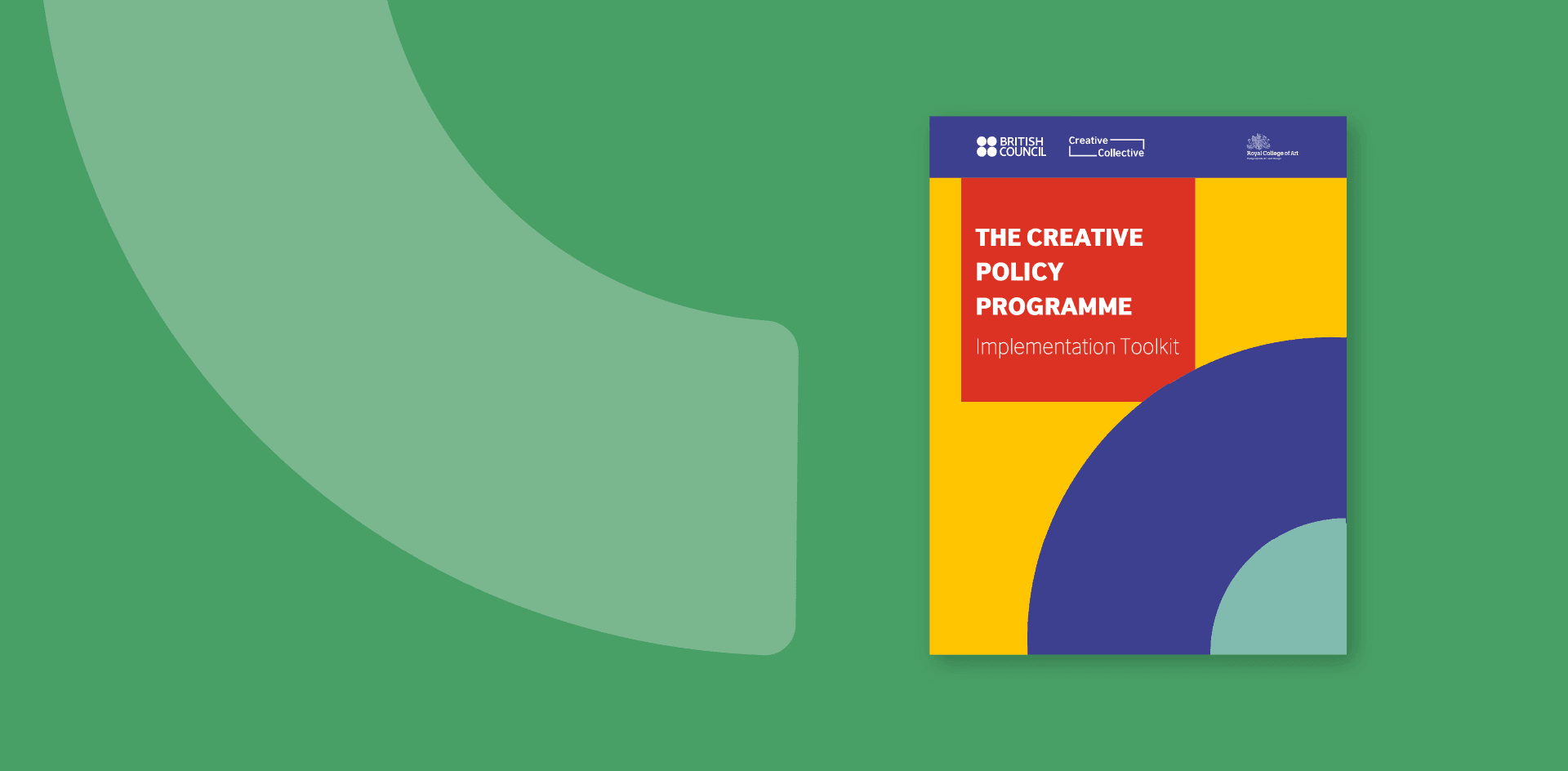
For the programme to have lasting impact, it needed to be replicable beyond the original cohort. The implementation toolkit —published openly under Creative Commons —translates the methodology into a practical guide that any facilitator can adapt. By documenting the principles, tools, templates, and facilitation approaches, it extends the programme’s reach to institutions that were not present and enables future editions to build on the accumulated learning.
The second edition in Puebla validated the territorial replicability of the model, adapting it to a state-level context with different institutional structures and policy priorities. This transfer demonstrated that the programme’s value is not specific to any single institutional setting, but is rooted in a methodology robust enough to travel.
Service Design as a Public Innovation Capability for Latin America
The Creative Policy Programme operates at the intersection of two transitions that are reshaping governance across Latin America. The first is the growing recognition that design —and specifically service design— is not just a tool for improving user experiences, but a capability for addressing the “wicked problems” of public policy: challenges that are complex, contested, contextual, and resistant to top-down solutions. The second is the expansion of the creative economy as a policy domain, moving from a narrow focus on cultural industries to a broader conception of creativity as a driver of social transformation.
What this programme demonstrated is that public servants are not resistant to innovation —they are eager for it. When given a structured methodology, real problems to work on, and space for genuine collaboration, they produce creative and rigorous policy propositions. The constraint is rarely motivation; it is methodological. Governments that invest in design capabilities for their public servants are investing in their capacity to solve problems rather than just administer programmes.
This case also shows the power of cross-institutional design partnerships. The collaboration between a British international organisation, a world-leading design school, and a Latin American public innovation consultancy brought together complementary capabilities that no single actor could have assembled alone. The British Council contributed convening power and an international perspective on creative economy policy. The RCA brought methodological depth and research credibility. UNIT brought contextual knowledge, facilitation expertise, and the ability to adapt the methodology to the specific conditions of Mexican public administration.
The open-access toolkit extends these lessons to any institution willing to engage with them. Published in both Spanish and English, it offers a fully documented implementation guide that can be adapted to different contexts, sectors, and scales —from national ministries to subnational governments to civil society organisations. In a region where public innovation capacity remains unevenly distributed, making this knowledge freely available is itself an act of public value generation.
The Creative Policy Programme proves that the question is no longer whether design and government belong together. It is how to build the capabilities, create the spaces, and develop the partnerships that make that combination sustainable at scale.