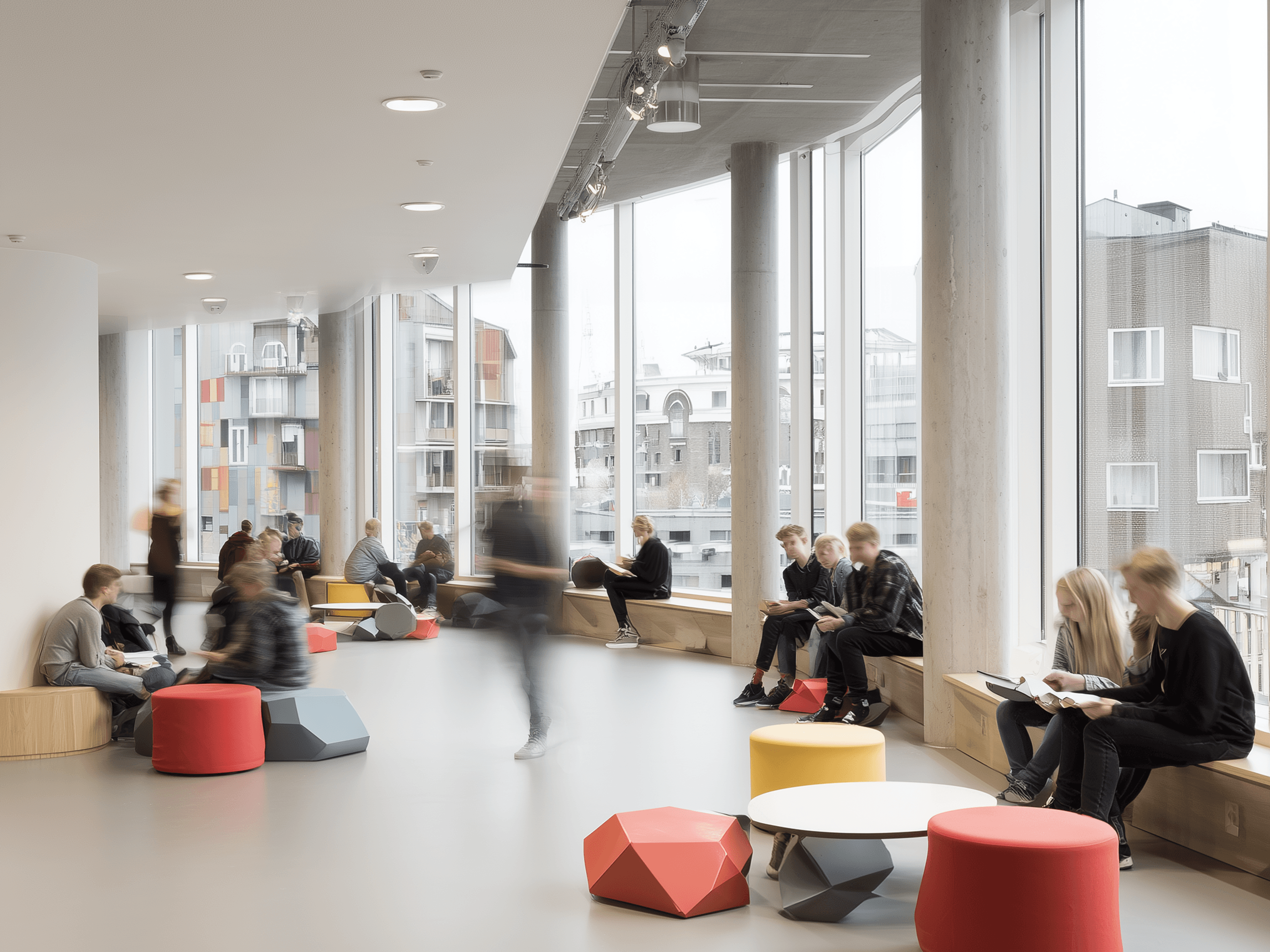

Redesigning Institutional Culture through Student Experience
UNIT partnered with Universidad Adolfo Ibáñez to redesign its student experience from the ground up —addressing a structural challenge of organisational fragmentation through service design and collective intelligence to install a culture centred on integral student development.
When the Student Experience Fragments into Institutional Silos
Universities face deep structural change: new generations with different expectations, non-linear educational paths, mounting pressure around employability, and accelerating digitalisation are reshaping the relationship with learning.
Yet many institutions continue managing improvement through sectoral logics. Specific services get optimised —enrollment, library, student portal— without addressing the student experience as an interconnected system. The result is typically a discontinuous journey where the academic, administrative, and emotional dimensions operate as silos.
At Universidad Adolfo Ibáñez (UAI), this tension became visible. The institution had solid services and committed teams, but lacked an architecture capable of understanding the educational experience as an integrated process. The absence of a systemic perspective made it difficult to align organisational culture, strategic decisions, and service design around a shared purpose.
The challenge was not one of operational efficiency, but of institutional coherence. Without an internal collaboration architecture connecting academic and administrative areas, any improvement risked addressing isolated symptoms without transforming the full experience. The university needed a structuring tool capable of ordering complexity and translating it into sustainable organisational capabilities.
University experience cannot be understood as a sum of isolated services. It requires a systemic perspective that connects culture, strategy, and design.
Designing the University Experience as a Collaboration Infrastructure
UNIT applied a service design methodology rooted in collective intelligence, moving from a static view of "service delivery" to seeing the student experience as a living trajectory.
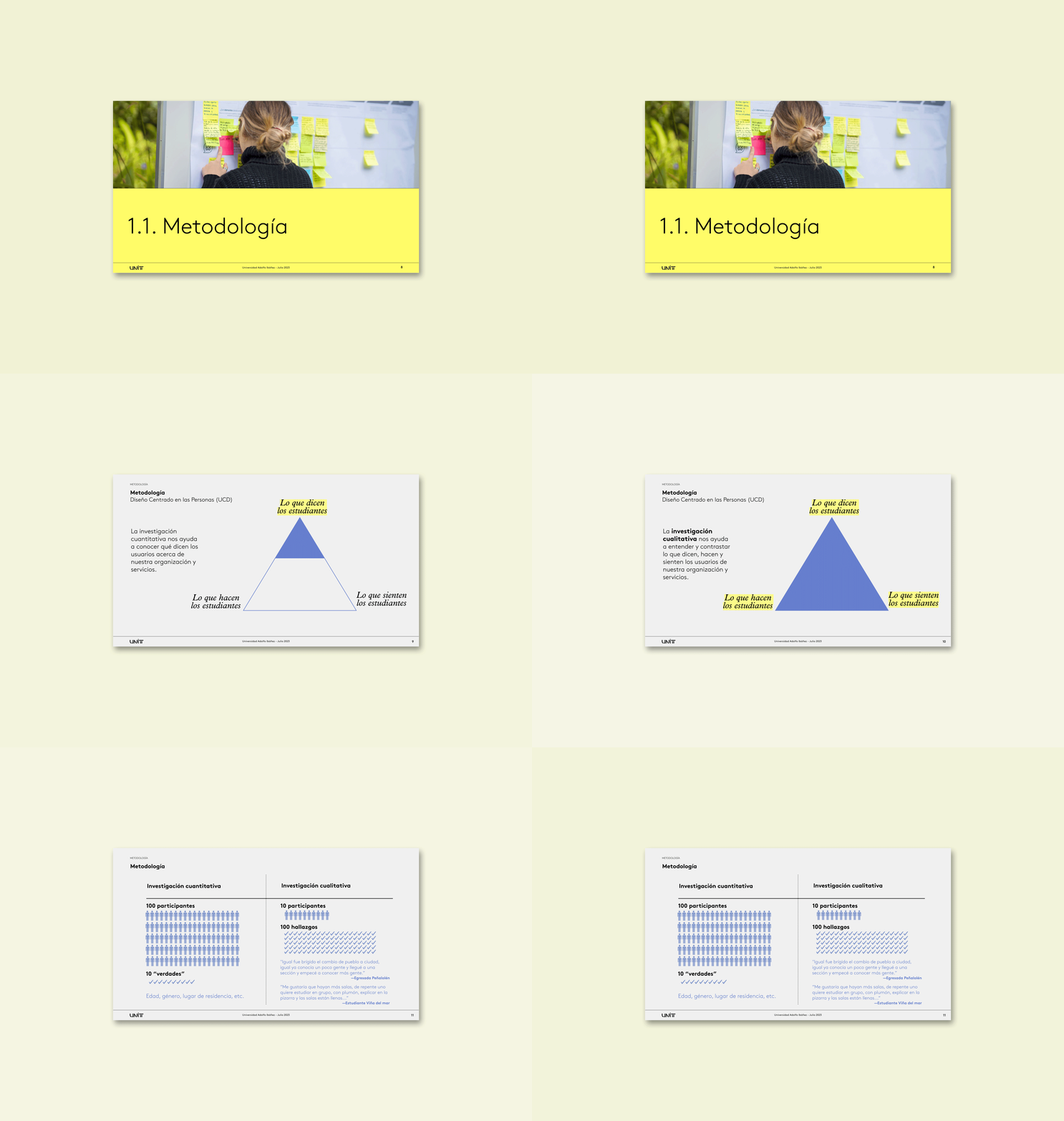
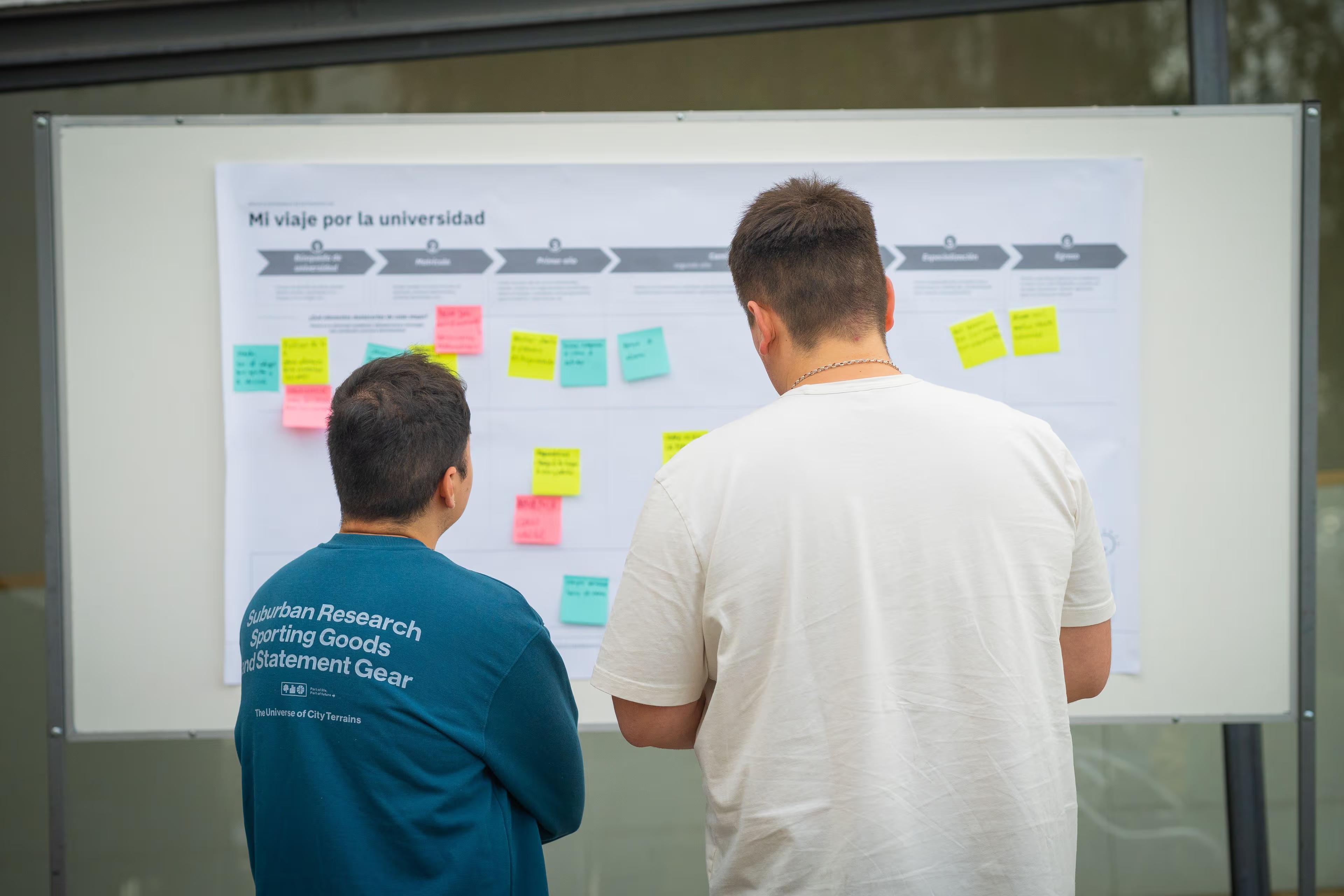
The process began with situated research to decode the system from within. Through guerrilla interviews, itinerant workshops, and in-depth sessions with over 100 students, we mapped critical friction points and emotional arcs. This was mirrored by institutional analysis involving 60+ staff and faculty members.
Rather than merely collecting perceptions, we uncovered structural patterns. This evidence shaped five distinct student profiles and journeys, proving that a non-homogeneous community requires strategic differentiation.
The result is the UAI Student Experience Model: a conceptual architecture spanning seven dimensions—from wellbeing to alumni networks—all centered on integral development. This shifted the institution’s logic from isolated fixes to systemic orchestration, installing a new organizational capability that aligns every intervention with a shared vision.
Impact
+100
Students actively involved in the research process
+60
Faculty and administrative staff mobilised across campuses
5
Student profiles built with their respective experience journeys
1
Institutional model adopted as a structuring framework for strategic decisions
Networks and Collaborations
The project was developed in collaboration with Universidad Adolfo Ibáñez, involving academic authorities, administrative teams, and admissions and student life units across its Chilean campuses.
Students from diverse programmes, socioeconomic backgrounds, and educational paths participated, alongside faculty and staff responsible for academic and administrative processes. This multi-level articulation enabled the installation of an internal collaboration infrastructure oriented toward strengthening institutional governance through experience. Building on this work, UAI has also launched a Latin American network of student experience-centred institutions, creating a platform for sharing methodologies, learnings, and results across the region.
When Organisational Culture Begins to Operate from Experience
The primary outcome of the project was not the creation of a model, but the transformation of institutional logic. UAI adopted the Student Experience Model as a structuring tool for strategic decision-making, investment prioritisation, and cross-area coordination. This reduced organisational fragmentation and strengthened coherence between culture, strategy, and design.
The approach went beyond diagnosis. In 2024, based on key gaps identified in satisfaction surveys, the model was applied to campus life interventions through agile prototypes and real-user testing. In 2025, the focus expanded to the undergraduate admissions process: more than 30 interviews with enrolled and prospective students, parents, and admissions staff revealed that the university experience begins well before enrolment, and that early contact with the institution is critical for building trust and connection.
A generative capability was thus installed: the university acquired tools to evaluate, redesign, and scale improvements from a systemic perspective. The student experience stopped being aspirational language and became an operational criterion. The value generated was not only functional. Internal conditions of trust and legitimacy were strengthened by actively involving students and teams in the co-construction of solutions.

A Replicable Model for University Transformation in Latin America
The UAI case speaks to a broader debate in higher education: how to move from universities organised by function to institutions articulated by experience.
In Latin American contexts, marked by institutional fragmentation and pressure for measurable results, designing internal collaboration infrastructure becomes essential for building sustainable educational public goods. The student experience is not a reputational accessory, but a system that articulates learning, belonging, and professional development.
This project demonstrates that collaborative innovation can operate within traditional institutions when collective intelligence, service design, and strategic leadership are combined. However, the model developed is not a closed recipe, but a replicable architecture that allows systemic principles to be adapted to different institutional realities.
Its scaling potential lies in something simple but structural: offering a tool that straightforwardly addresses the connection between culture, strategy, and operations under a single framework. In a landscape where many universities seek to differentiate services obliviously of how they relate to each other, this case shows that real transformation happens when design is focused on organisational coherence; in particular, when student experience, understood as a living system, becomes an axis of institutional policy —not just a functional area.
Putting students at the centre is not a statement of principles. It is a structural decision that requires redesigning how the institution works.